
How Often Should Custom Made Orthotics Be Replaced?
- Lakeshore Orthotics
- 2 days ago
- 6 min read

If your orthotics still fit in your shoes, it is easy to assume they are still doing their job. That is not always true. When patients ask how often should custom made orthotics be replaced, the real answer depends on wear, body changes, activity level, and whether the device is still supporting the way it was designed to.
Custom orthotics are built to improve alignment, redistribute pressure, and reduce strain through the feet, ankles, knees, hips, and lower back. They are not meant to last forever. Even well-made orthotics gradually lose structure, cushioning, and corrective value with daily use. If they are worn out, the support may decline slowly enough that you do not notice until pain, fatigue, or gait changes return.
How often should custom made orthotics be replaced in most cases?
For many adults, custom made orthotics need replacement every 1 to 5 years. That is a wide range because not all orthotics, footwear habits, and patient needs are the same.
A person who wears orthotics all day at work, walks long distances, or exercises regularly will usually wear them out faster than someone who uses them only in one pair of casual shoes. Materials also matter. A rigid functional orthotic may hold its shape longer than a softer device focused more on cushioning and pressure relief. Even so, durability is only part of the picture. An orthotic can still look intact while no longer matching your current biomechanics.
That is why replacement should not be based on appearance alone. The better question is whether the orthotic is still giving you the support and comfort it was prescribed to provide.
What affects how long orthotics last?
Daily use is one of the biggest factors. If you wear custom orthotics for work, errands, exercise, and standing throughout the day, the top cover, posting, and base materials take repeated stress. Over time, the device may compress, flatten, crack, or shift.
Your body can change too. Weight changes, injury, surgery, pregnancy, arthritis progression, diabetes-related foot changes, and age-related changes in joint mobility can all affect how your orthotics fit and function. An orthotic made for your gait two or three years ago may no longer be the best match today.
Footwear also plays a role. Moving orthotics between shoes that do not have enough depth or stability can place extra strain on the device. In some cases, the orthotic wears down because the shoe itself is no longer supportive.
Children and teens usually need more frequent reassessment because their feet are still growing. Adults with stable biomechanics may go longer between replacements, but only if the orthotics remain effective and are checked periodically.
Material wear is not always obvious
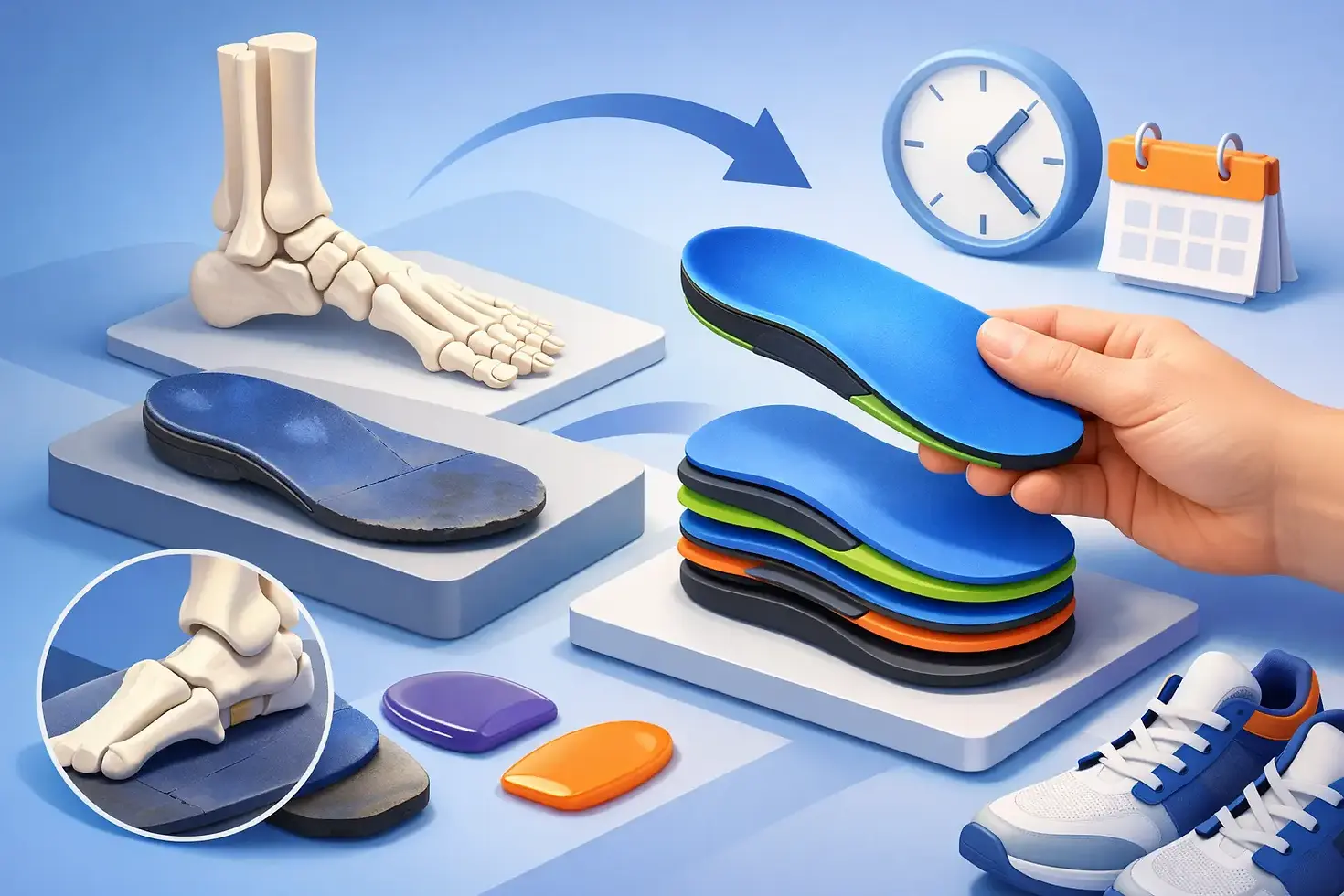
Many people expect worn orthotics to look damaged. Sometimes they do. You may see peeling covers, cracks in the shell, compressed heel padding, or uneven edges. But sometimes the change is more subtle.
A custom orthotic can lose corrective control before it shows obvious physical damage. The arch support may soften. The heel may not stabilize as well. Pressure redistribution may become less effective. If your symptoms are returning, that matters even if the orthotic still looks serviceable.
Signs your custom orthotics may need to be replaced
Pain returning is one of the clearest signs. If heel pain, arch pain, forefoot pain, shin discomfort, knee strain, or low back fatigue starts to come back, your orthotics may no longer be performing as intended.
You may also notice that your feet feel more tired by the end of the day, especially during standing or walking. Some patients describe this as feeling less supported, even if they cannot point to visible damage.
Changes in shoe wear can also tell you something. If one side of the shoe starts breaking down faster, or your foot seems to roll differently than before, your gait mechanics may have changed.
Watch for fit changes too. If the orthotic shifts inside the shoe, no longer sits properly under the arch, feels unusually hard, or causes rubbing in areas that were previously comfortable, it should be reassessed.
Common signs that should prompt a reassessment
If you notice any of the following, it is a good time to book an orthotic check:
your original pain or pressure symptoms are returning
the orthotic looks cracked, flattened, or uneven
the top cover is peeling or the cushioning feels compressed
your shoes are wearing down differently than before
you have had a significant weight change, injury, or surgery
you are wearing the orthotics much more than when they were first prescribed
Replacement versus reassessment
Not every issue means you need a completely new pair. Sometimes the orthotic needs an adjustment, refurbishment, or new top cover rather than full replacement.
This is where a proper reassessment matters. A clinician can look at how the orthotic has worn, how your foot sits on it now, how your shoes are interacting with it, and whether your gait has changed. If the shell is still structurally sound, minor modifications may extend its useful life. If the device no longer matches your biomechanics, replacement is usually the better choice.
Patients often try to judge this at home by feel alone. That can be misleading. If support has gradually declined, you may adapt to the change without realizing it. A gait and biomechanical review gives a clearer answer.
How often should custom made orthotics be replaced if you are very active?
If you walk a lot for work, spend long hours standing, run, train regularly, or use orthotics in multiple shoes every day, you may need replacement closer to the 1 to 2 year range.
High activity means more compression and more repetitive loading. This is especially true for patients using orthotics to manage plantar fasciitis, overpronation, tendon strain, metatarsal pressure, or sports-related overuse issues. In these cases, waiting too long can allow mechanics to worsen again and may increase stress higher up the chain at the knees, hips, or back.
On the other hand, if your orthotics are used lightly and you have had no major physical changes, they may last several years. The right schedule is not identical for every patient.
Medical conditions can change the timeline
Some patients should be checked more closely even if the orthotics seem fine. Diabetes, arthritis, neuropathy, circulation concerns, and chronic pain conditions can all affect tissue tolerance and pressure distribution.
For these patients, a worn or poorly matched orthotic is not just a comfort issue. It can increase pressure in vulnerable areas, reduce stability, and make day-to-day movement harder. If you have an ongoing medical condition affecting your feet or lower limbs, regular follow-up is a better approach than waiting for obvious pain.
Why delaying replacement can create bigger problems
When orthotics stop doing their job, symptoms often build gradually. A little foot fatigue turns into heel pain. Mild instability turns into knee soreness. Pressure points become harder to ignore. Because the change is slow, many patients keep using the same orthotics long after they should have been reassessed.
That delay can affect more than the feet. Custom orthotics are meant to support the mechanics of walking and standing. If that support changes, the body compensates. Over time, small alignment issues can contribute to discomfort in multiple areas.
Replacing orthotics too early is unnecessary. Replacing them too late can mean more pain, more strain, and a longer recovery period.
The best time to book an orthotic check
A practical rule is to have your orthotics reviewed every 12 to 24 months, or sooner if symptoms change. That does not mean you will need a new pair every year. It means you should not guess.
A review is especially worthwhile if you have started a new job with more standing, changed your exercise routine, had an injury, noticed uneven shoe wear, or feel that your support is not what it used to be. Patients in Burlington, Hamilton, Oakville, and Mississauga often wait until pain is back in full force. Earlier reassessment is usually the better route.
At Lakeshore Orthotics & Wellness Center, this kind of follow-up is part of making sure your orthotics are still doing what they were made to do.
Custom orthotics are not a one-time purchase you forget about. They are part of an ongoing care plan for movement, support, and pain relief. If yours are older, feel different, or are no longer giving you the same results, that is reason enough to have them checked before small problems become daily ones.


Comments